
Call now(720) 600-6733
Rated in cycles, not years, and it uses them up faster than anyone expects. The moment it goes, a motor designed to guide the door is asked to lift all of it.
Tell us what the door is doing. Free estimate, no strings.
When a broken torsion spring happens in Denver it happens without warning. Across Denver County, it's the loaded parts that fail, and they pick an ordinary morning rather than a storm. Across Denver County the pattern is consistent: hail dents panels and the freeze-thaw swings crack old lubricant and stiffen springs, and 1950s brick ranches and bungalows in the older neighborhoods, big two- and three-car garages on the newer builds out east take the worst of it.
The spring isn't what lifts the door. It's what cancels the door's weight. Between 130 and 190 pounds for a double steel door, and heavier insulated. With the spring wound, the door behaves as though it weighs nothing, and half a horsepower is plenty. A broken spring ends the balance at once, and the opener is left holding a weight it can't lift.
We cover Denver and the towns around it - Aurora, Lakewood, Arvada, Littleton, Englewood, Thornton. You decide before anything starts, and the estimate is free either way.
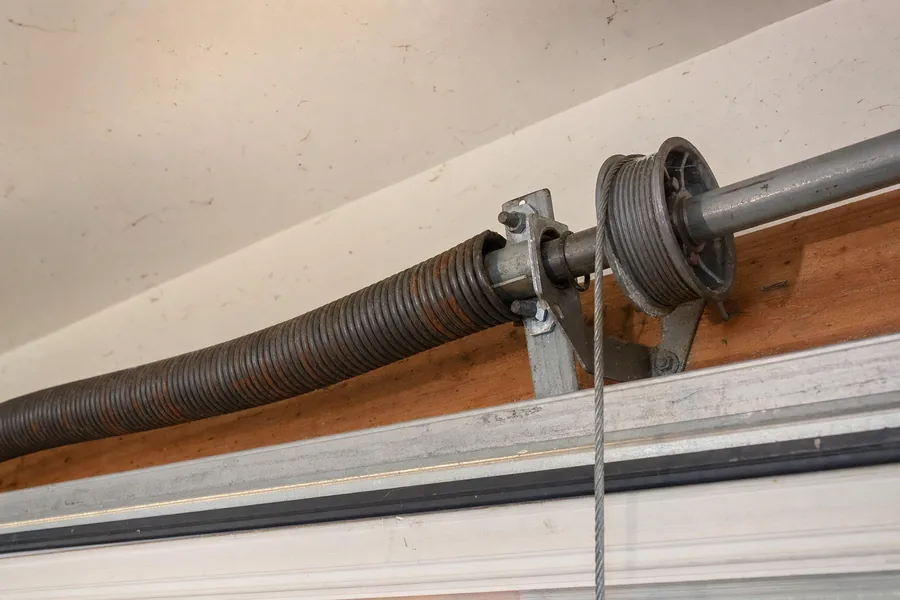
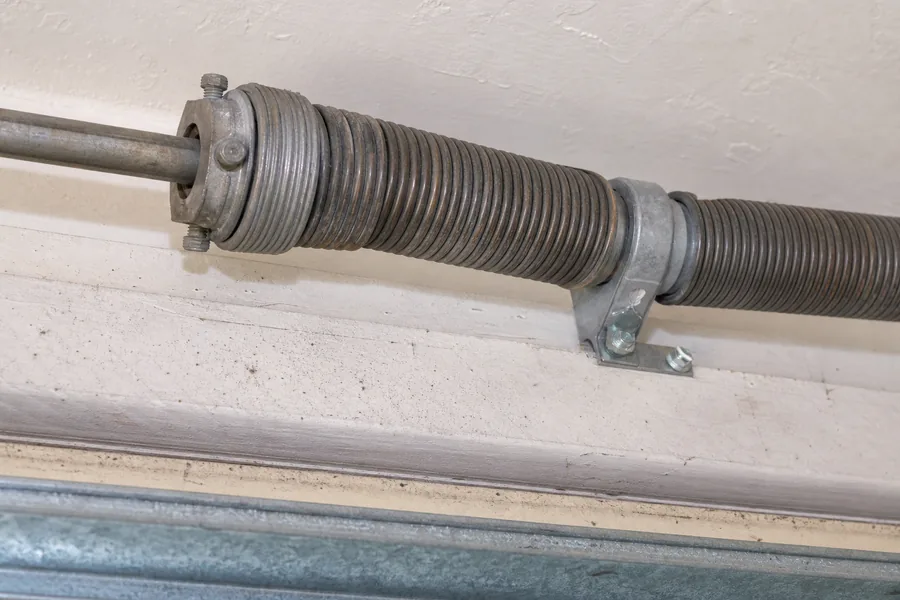
If you were in, you heard it, and you won't forget it. One flat bang, like a heavy book hitting a concrete floor. Overnight cooling contracts the steel, and that's the moment a worn spring picks.
If any of that sounds familiar, a technician can confirm it on site in about ten minutes. Rather than guess over the phone, we come and look, free.
Measured in trips rather than years, the failure is predictable. A cycle is a single up-and-down, and the standard builder spring lasts about ten thousand. Four cycles for two cars going out and coming home, plus school drop-off, plus the trash cans. Call it six. Six cycles a day is 2,190 a year, so a ten-thousand-cycle spring is used up in under five years. Nothing has gone wrong when it breaks. It has simply been used up.
A spring is a wire gauge, an inside diameter and a length, and the combination must suit the door's weight. Close-enough springs fail early. We measure the old one and weigh the door before installing anything.
The two springs are the same age and have done identical work. When one breaks, the other isn't fine. The other spring is on the same clock, and it's weeks from running out. That is why we show you both. You can do one. The other becomes a separate, foreseeable visit.
It gets postponed a lot, so it's worth saying plainly what postponing leads to. None of the following is unusual. It's the ordinary sequence, and we see it in Denver every week.
The estimate is free, so finding out where you stand asks nothing of you. Call early and you avoid all of that.
This is the job that injures people. The one. The tension is still in the unbroken half, and very little holds it. Released the wrong way, the tension leaves at once, and fingers go with it. A crescent wrench is not a proper tools. Neither is a screwdriver.
The rule with a failed door is simple: stop using it. Each attempt to run a door with a failed counterbalance shifts the load somewhere it doesn't belong, and the job grows with it.
To get the car out first: door fully closed, red cord pulled, then lift with two hands and a straight back. If the door doesn't move easily, leave it. It's telling you the counterbalance is gone.
You can, and we will if that's what you want. Springs on a door age as a pair. The one that hasn't broken yet has done exactly as many cycles as the one that did. You see both springs, then you decide.
An overpowered spring is as bad a fit as an underpowered one. The door rises unasked, closing is a battle for the opener, and the reversal stops working as it should. We match the spring to the door's true weight rather than going bigger.
It almost never does. The door is a thirty-year item and the spring is not. Replacing the spring on an otherwise sound door is a normal repair, not a sign the door is finished. If somebody recommends a whole new door before they've even looked at the panels, they are there to sell you one.
None of that is unique to Denver. It's the natural result of guessing at a door over the phone. So we don't guess; we send somebody to look first.
Springs don't wear out gradually in a way you can see. They hit their cycle limit and break, often first thing in the morning when the metal is cold.
With a broken spring or cable, no. Leave it down and don't force it. A wound spring carries a lot of stored energy and gives no warning before it releases.
Usually, yes. We hold same-day slots for Denver and the surrounding towns, and a door stuck open or a car shut in goes to the front of the list.
Yes. We come out and tell you what has failed, anywhere in Denver County, with no obligation either way.
We'll show you both springs. The one that didn't break has done exactly the same number of cycles as the one that did, so it's usually a few weeks behind. Two visits for one job is the alternative.
Yes. The line is open around the clock, seven days a week, and a door stuck open or a car shut in gets an after-hours visit the same night.
The call is a question, not a booking. Many people phone to ask if it can wait, hear that it can, and take a slot next week. That's a fine outcome, and the estimate asks nothing of you.
If it's urgent. A door that won't close, or a car trapped behind one. Say the word and it becomes the next stop. Denver, Denver County and the towns around it.
Tell us the symptoms and we'll give you a window, not a guess. The visit and the estimate is free, anywhere in Denver County.
Prefer to talk it through? Call (720) 600-6733.
Tell us what the door is doing. Free estimate, no strings.