
Call now(720) 600-6733
Frayed strands near the bottom bracket are the warning sign. When it snaps, that's the emergency, and the door usually leaves its track with it.
Tell us what the door is doing. Free estimate, no strings.
A snapped cable or seized roller is the fault we're called out for most often in Denver, and it is the one homeowners least expect. Anywhere in Denver County, you see nothing, hear nothing, and then one morning the door won't budge and your car is on the wrong side of it. Around Park Hill and Washington Park we see it concentrated in 1950s brick ranches and bungalows in the older neighborhoods, big two- and three-car garages on the newer builds out east, where hail dents panels and the freeze-thaw swings crack old lubricant and stiffen springs.
The two cables start at the bottom brackets, climb the sides, and wrap onto drums on the torsion shaft. They are what carries the door's weight up to the spring. One cable failing drops that side of the door, jams it, and derails it. That's why a broken cable and a derailed door are usually the same phone call.
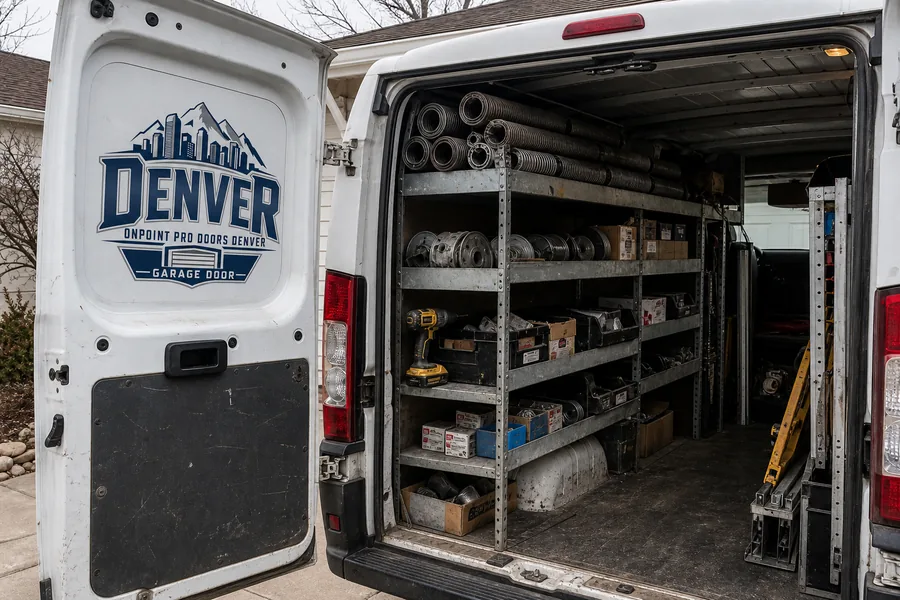
The van covers Denver and Aurora, Lakewood, Arvada, Littleton, Englewood, Thornton daily. Across Denver County, two-hour arrival window rather than a day, a free estimate, and what you agreed on the driveway is what happens.
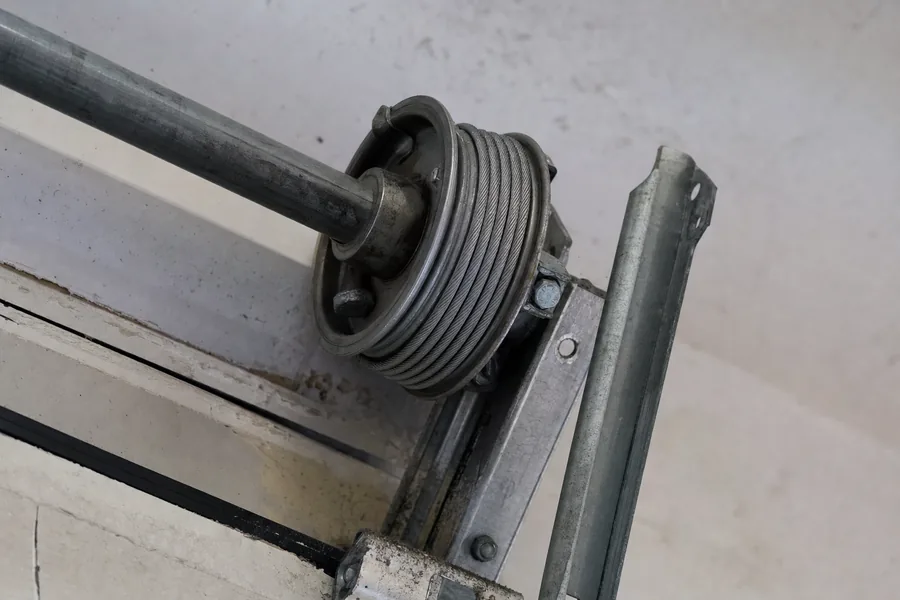
A cable warns you before it goes. Run your eye along it: broken strands stick out of the wire like whiskers, usually near the bottom. Compare the two sides. A slack cable opposite a tight one means the drum has already been slipped. Crooked closing means the warning has already passed.
If any of that sounds familiar, a technician can confirm it on site in about ten minutes. Rather than guess over the phone, we come and look, free.
A galvanized cable lasts as long as its coating, and that holds across Denver County. Down at the bottom bracket the cable is closest to a wet floor. In Denver and the towns around it, the galvanizing goes there first, and the strands follow. The roller story is short. Builder plastic, no proper bearings, finished inside seven years.
Cables come in pairs for a reason: equal wear, equal drum setting, level door. Sealed-bearing nylon rollers are the upgrade that earns its keep. Less noise, and a lifespan several times that of plastic.
A seized roller takes the track with it, so a roller swap left too long becomes a track repair. With the van there for a cable, rollers are a few extra minutes.
It gets postponed a lot, so it's worth saying plainly what postponing leads to. None of the following is unusual. It's the ordinary sequence, and we see it in Denver every week.
The estimate is free, so finding out where you stand asks nothing of you. Call early and you avoid all of that.
The bottom bracket the cable attaches to carries the full spring load. That bolt is the most dangerous on the whole door, which is why it usually carries a warning. Loosen it without unloading the spring first and the whole counterbalance releases at once.
The rule with a failed door is simple: stop using it. Each attempt to run a door with a failed counterbalance shifts the load somewhere it doesn't belong, and the job grows with it.
To get the car out first: door fully closed, red cord pulled, then lift with two hands and a straight back. If the door doesn't move easily, leave it. It's telling you the counterbalance is gone.
Plastic rollers without bearings, the kind most builders install, last about five to seven years. Nylon on sealed bearings: quieter, easier on the track, and a lifespan several times that of the builder's rollers.
Cables are replaced in pairs. The two cables age together, and unless the drums are set evenly the door never hangs level again.
It's possible, and by the time it happens the cable won't be the only casualty. With that side dropped the door jams and usually derails, which turns a cable replacement into track and hinge repairs. A fraying cable is giving you advance warning, which is more than a spring ever does.
None of that is unique to Denver. It's the natural result of guessing at a door over the phone. So we don't guess; we send somebody to look first.
Both cables, always. They're the same age with the same wear, and the drums need setting evenly or the door never sits level again.
Yes. Whether it's a LiftMaster, a Chamberlain, a Genie, a Craftsman, a Clopay, an Amarr or a Wayne Dalton, we work on it. The mechanisms are much the same from brand to brand, and the van carries parts for all of them.
Yes. Call at any hour and you get dispatch, not a recording. A door that won't shut is handled that night.
The bottom of the cable sits in the damp near the floor, and that's where it corrodes and frays. It's been going for weeks by the time it snaps. You just couldn't see it.
Most garage door cable and roller repair jobs are finished within the same visit, typically under two hours.
Yes - Aurora, Lakewood, Arvada, Littleton, Englewood, Thornton and the wider Denver County area are all inside our normal service radius.
The call is a question, not a booking. Many people phone to ask if it can wait, hear that it can, and take a slot next week. That's a fine outcome, and the estimate asks nothing of you.
If it's urgent. A door that won't close, or a car trapped behind one. Say the word and it becomes the next stop. Denver, Denver County and the towns around it.
A two-hour slot, and a call on the way. Free throughout Denver County, with no obligation either way.
Prefer to talk it through? Call (720) 600-6733.
Tell us what the door is doing. Free estimate, no strings.