
Warehouses, auto shops, storage buildings, restaurants with roll-up fronts and service bays across the metro depend on doors that open all day and lock up at night. OnPoint Pro Doors repairs sectional overhead doors, rolling steel doors, roll-up doors and the operators behind them, with a free estimate before any work.
Tell us the symptoms. Free estimate, no strings attached.
A commercial door is heavier, wider and busier than anything on a house. A loading door at a warehouse can cycle more times in a week than a home door does in a season, and its springs, cables, rollers and operator are sized for that.
Three kinds cover most of what we see: sectional overhead doors that roll up on tracks, rolling steel doors that coil into a barrel above the opening, and lighter roll-up doors on storage buildings and small bays. Each has its own parts, so a quick description on the call, or a photo of the label, means the right ones come along.
Summer hail dents commercial doors as readily as house doors, and on a wide sectional door a folded strut or a creased panel is enough to make the door bind on the tracks. Creased sections come out one at a time, and a bent strut is swapped so the door runs straight while you decide about the rest.
The gusts that come off the foothills are a different hazard. A wide door caught partway open acts like a sail, and the result is bent track, rollers out of their channel or a section cracked at the hinges. Wide doors on exposed lots get the bracing and struts the maker specifies, fastened into sound structure.
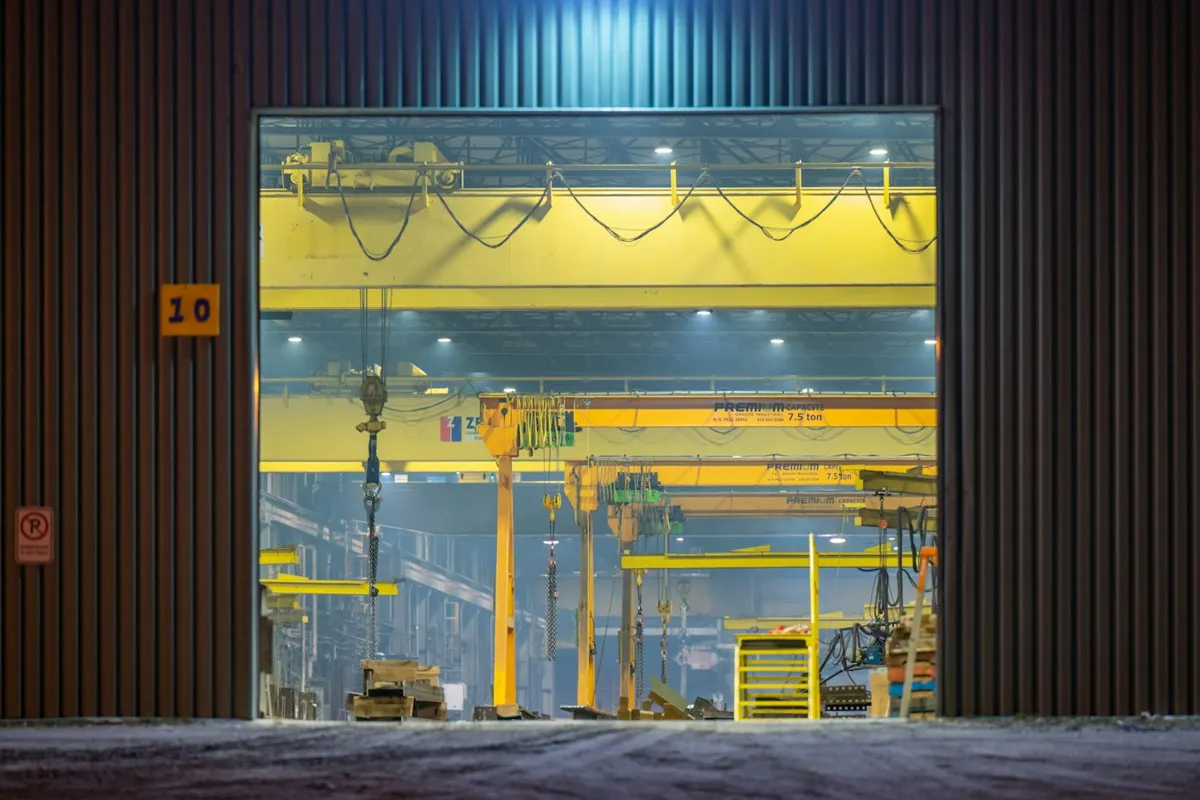
Rolling steel doors carry their springs inside the barrel above the opening. When the springs tire, the door gets hard to lift by chain or the operator strains and stops partway. A curtain that runs crooked or catches usually means a bent guide, a loose slat or a damaged bottom bar, and each of those can be repaired without replacing the curtain.
Sectional doors lean on torsion springs, cables and drums above the opening, and the hardware is bigger than on a house door. Roll-up doors on storage units have a simpler spring in the drum and fail at the latch, the strap and the bottom edge.
Whatever the door, the technician confirms the cause before replacing anything, and each repair appears separately on the estimate.
Every spring is good for a certain number of cycles. On a busy door that number comes quickly, which is why a business door that breaks springs again and again usually needs high-cycle springs, wound from heavier wire to last far longer between replacements.
Cables wear with the springs. A frayed cable near the bottom bracket, or one that has jumped its drum, is replaced with the spring tension safely released first. Forcing a big door with a snapped spring is how people get hurt, so keep everyone back from it and let it sit where it stopped until the technician gets there.
Commercial operators sit at the end of the same power lines that lightning loves in July. After a strike nearby, an operator may go dead, ignore its push buttons, or run without stopping where it should because its limit settings were scrambled. Boards, limit switches and controls are diagnosed before a whole operator is condemned.
Each visit ends with the safety edge on the bottom bar and the photo eyes at the opening proven to stop and reverse the door. A heavy door that will not reverse is a serious hazard in a busy bay.
Doors still raised by hand chain can be motorized, with an operator sized to the door and a three-button station where staff actually use it.
Warm afternoons and freezing nights work on a commercial door the way they work on a house door, only on a bigger scale. Steel expands and shrinks, fasteners loosen in the track, and the bottom seal hardens and cracks after a few winters until daylight shows under the door.
For a heated shop or a warehouse with temperature-sensitive stock, that gap matters. New bottom seals, brush seals along the guides of a rolling door and weatherstripping around a sectional door keep drafts, dust and blowing snow out, and they are usually replaced during the same visit as the repair.
Insulated sections are available for many sectional doors when a building is heated, and a lighter uninsulated door often makes more sense for cold storage, where it is easier on the springs.
Scheduled around your business hours whenever the door allows it.
A door that won't come down at the end of the day leaves a business exposed, and that call is treated accordingly. Say on the phone that the building can't be secured, and the visit is about one thing first: getting that door down and locked. If the proper fix needs a part on order, it comes back for that afterward.
Multi-door buildings get the same efficiency in reverse: while the technician is on site for one door, the others can be looked over and listed on the same estimate, so a second door that is starting to grind gets caught before it fails during a busy week.
It is. Barrel springs, curtains, slats, guides, bottom bars and their operators, plus sectional overhead doors and the roll-ups on storage buildings.
Usually not. Dented sections and folded struts are replaced individually, and the door is run and balanced again.
Often. A surge can damage a board, limit switch or control, and those are checked and replaced before anyone suggests a new operator.
Standard springs wear out quickly on a busy door. High-cycle springs are built for many more openings and are the usual fix.
Most can. Balance comes first, so the new operator guides the door instead of hauling it, and then the controls go where your crew works.
Usually. A worn bottom seal, brush seals on the guides and new weatherstripping close most gaps, provided the slab and the door sit level.
Yes. Give us the hours the bay can sit closed and the work is planned inside them, with any other doors on site looked at during the same trip.
Yes. Once the door and its operator have been gone over, you receive the estimate in writing, free, and decide from there.
Describe the fault and we'll give you an honest arrival time. The visit and the estimate is free, wherever you are.
Would rather call? Call (720) 600-6733.
Tell us the symptoms. Free estimate, no strings attached.