
From a single alley garage in the older neighborhoods to a three-door garage on a newer street out east, a smart opener puts every door on your phone. We install openers with Wi-Fi built in, add app control to good openers already on the ceiling, and repair the ones that lost the connection. The estimate is free.
Tell us the symptoms. Free estimate, no strings attached.
Plenty of the newer houses here have two or three garage doors, each on its own opener, plus a keypad, a stack of remotes and the buttons in two or three cars. A smart setup brings all of them onto one screen: which doors are open, which are shut, and who used them last.
Each door keeps its own opener and its own safety eyes. What changes is that the app sees every one of them, so the door left up over the boat bay gets noticed from the office instead of at bedtime.
It is also a good time to start the pairing over. Every opener's memory is wiped, then the household's own remotes, keypad code and car buttons are taught back door by door, so nothing from a previous owner still works.
The core of it is simple: open and close from the app, get a notice whenever a door moves, and get a warning when one has stood open too long. Most systems keep a history and let you add family members or give a visitor temporary access.
Depending on the model, you may also get a timer that closes the door by itself after a set time, a camera inside the garage, or the ability to connect with some newer cars. Genie's openers pair with the Aladdin Connect app, while LiftMaster and Chamberlain both use myQ. Basic control is usually included; some extras, such as saved video, can carry a charge from the maker.
For an alley garage, the timer is often the feature people end up loving. A door that slides shut by itself half an hour after the last car pulls in means no more lying awake wondering whether the garage is open to the alley, and the app sends a note each time it does it.
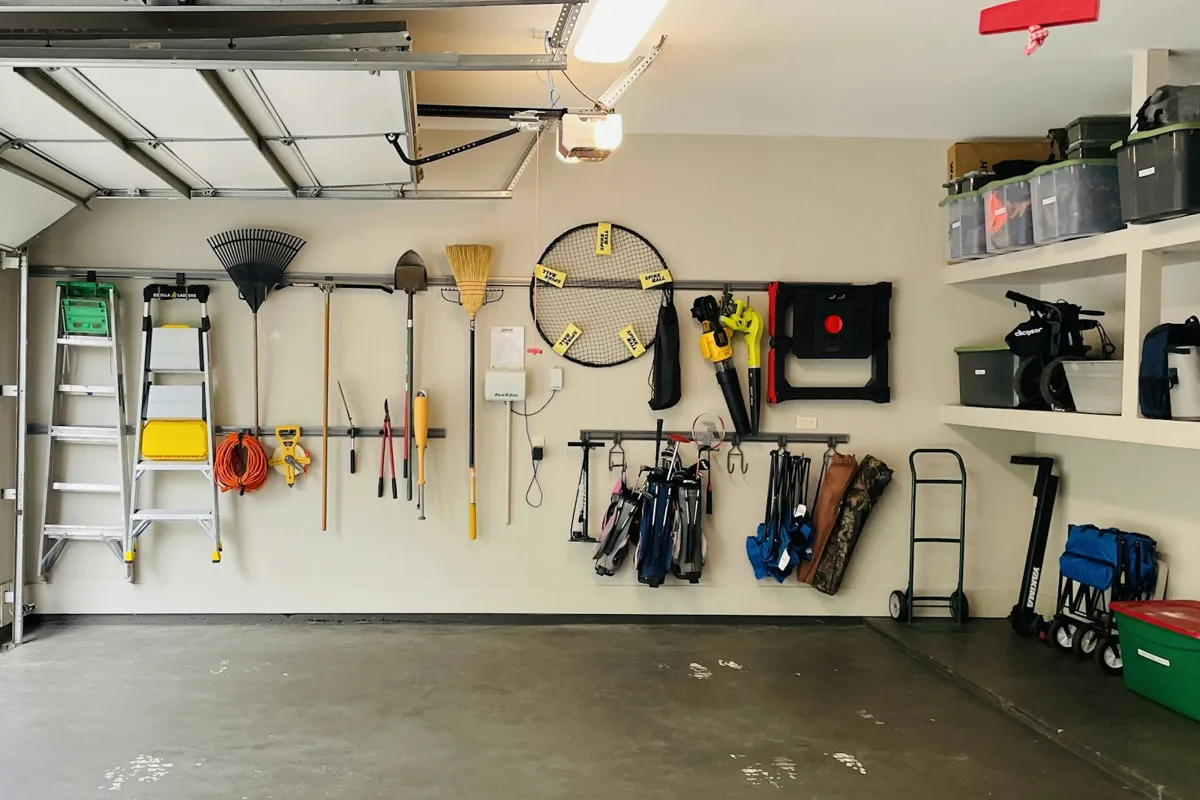
If the opener on your ceiling is a current model, it may already have Wi-Fi and only need connecting. If it is older but sound, an add-on controller can give it app control: a small unit near the motor and a sensor on the door that reports its position.
Some openers should not get one. A unit without working safety eyes, an opener that already labors to lift a heavy insulated door, or one with a failing board is better replaced, and a new unit arrives with modern rolling-code remotes and, on many models, a backup battery as well as the app.
On a tall or heavy door, a wall-mounted unit beside the door on the spring shaft is worth a look; it frees the ceiling and suits garages with storage racks overhead.
In the older neighborhoods the garage often stands off the alley, a long way from the router inside the house. Many smart openers use only the 2.4 GHz part of a router's signal, and by the time it crosses the yard and the garage wall, little of it may be left. The signal is measured at the door before anything is ordered, and a mesh point or extender closer to the garage is the usual cure.
Power is the other alley-garage issue. A garage fed by a cord strung from the house, or one sharing a circuit with a chest freezer, drops off the app for the same reasons its opener stalls. That gets fixed first, with an electrician suggested if the garage needs a proper outlet at the ceiling.
Summer afternoons bring lightning and short power cuts, and both the opener's board and the small controller that talks to the app sit at the end of that wire. After a flicker, an opener might come back fine but stay offline in the app, or go dark altogether.
Offline after an outage often means the opener and the router came back at different times and never reconnected; dark usually means a damaged board. A surge-protected outlet guards whatever is installed, and an opener with battery backup keeps the doors usable through an evening without power.
Hail season adds one more thing to watch. A section dented in a June storm can rub the track, and a door that binds on its way down gets reversed by the opener, which is exactly what it should do. From the app it simply looks like the door refused to close, so a door that suddenly starts reopening after a storm is worth a look at the sections and track before anyone blames the electronics.
The springs do the heavy lifting on any garage door; the opener only steers. Insulated two- and three-car doors are heavy, and when a spring weakens, the opener feels it first, usually on a cold morning when the grease is stiff and the bottom seal is stuck to the slab.
On a smart setup that shows up as a door that stops short or reverses while nobody is watching. That is why the springs, cables and balance are checked before any smart install, and why the app's closing warning, the photo eyes and the auto-reverse are all tested before we leave.
Same order for one door or three.
Yes. Each door keeps its own opener, and the app shows and controls all of them from one screen.
Often, if it has working safety eyes and the door is balanced. Openers that struggle with the door or have no eyes are better replaced.
The signal is measured at the door first. If it is weak, a mesh point or extender closer to the garage usually solves it.
Without power the opener can't run unless it has battery backup, which many current models carry. If an outage leaves a car shut inside, call us.
Openers built for app control give a warning light and sound before closing, and they rely on the photo eyes and auto-reverse, which are tested at every install.
Yes. It is usually the network, the door sensor or the opener's board, and the visit starts with the likeliest cause.
Yes. The doors, the openers and the signal are checked, and you get a free written estimate before any work.
Describe the fault and we'll give you an honest arrival time. The visit and the estimate is free, wherever you are.
Would rather call? Call (720) 600-6733.
Tell us the symptoms. Free estimate, no strings attached.